How far can a Fortnite Bronze to Unreal speedrun go in Reload ranked?
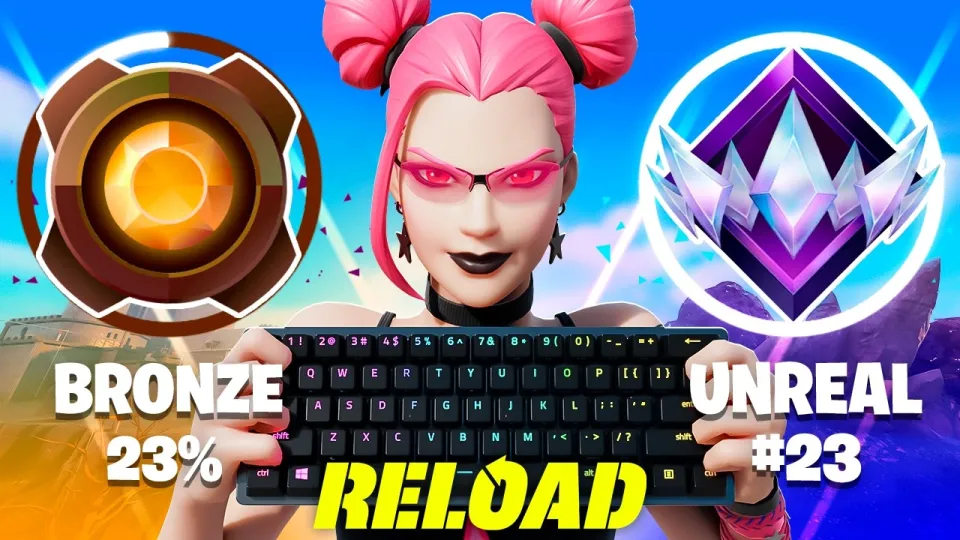
Video: BRONZE To UNREAL Ranked Speedrun In Fortnite Reload!
Need articles like this for your video? They help promote it on YouTube and Google — order them in the Telegram bot @sat_sit_bot. The bot writes and publishes the articles itself (with your YouTube video embedded) on popular topical websites (no ads). Free trial — 50 articles.
· based on the channel HaloBT
A Fortnite Bronze to Unreal speedrun in Reload is a single continuous climb through every ranked division — Bronze, Silver, Gold, Platinum, Diamond, Elite, Champion and finally Unreal — played mostly solo in fill lobbies rather than with a fixed squad. Because Reload lets you respawn while your team is alive, the mode rewards aggression and fast re-engagement, which is exactly what makes a fast climb possible. The run documented by creator HaloBT on his channel starts at the bottom of the ladder and pushes toward Unreal without resetting progress, and you can follow his maps and updates through his Fortnite creator page.
What does a Bronze to Unreal speedrun in Fortnite actually require?
A Bronze to Unreal speedrun requires clearing eight ranked tiers in as few matches as possible, which means maximizing placement points and eliminations in every single game. Fortnite's ranked system moves you up faster when you outperform the lobby's expected skill level, so a strong player in Bronze gains rank extremely quickly at first and then slows down as opponents improve. The practical requirements are simple to list but hard to execute:
- Win or place very high in early lobbies, where point gains per match are largest.
- Bank consistent eliminations — placement alone rarely carries a climb through the middle tiers.
- Avoid zero-point games, since a bad match in a speedrun costs both time and momentum.
- Keep the same account and mode so rank progress accumulates without interruption.
- Play long enough in one stretch that the ladder actually moves — this is a marathon disguised as a sprint.
The early divisions usually fall fast. Bronze and Silver lobbies are full of players still learning build fights and rotations, so a mechanically confident competitor can chain strong results. The real test begins when the game starts matching you against players who already know the map, the loot pool and the Reload respawn rhythm.
Why Fortnite Reload changes the ranked climb
Fortnite Reload changes the ranked climb because respawns remove the usual cost of an early death, turning matches into extended team fights instead of one-life survival. In standard battle royale, a single bad drop can end your game in ninety seconds and cost you rank points. In Reload, as long as a teammate is standing, you come back, which means aggressive players can take more risks and recover from mistakes.
That cuts both ways during a speedrun. On one hand, you can farm eliminations and stay in the match longer, which supports point gains. On the other hand, fill teammates who die repeatedly or wander off alone can drag the whole squad down, and the mode's smaller, denser map means third parties arrive quickly. A speedrunner has to decide early whether to play around random teammates or treat them as disposable cover while pushing for personal stats.
Where the climb stalls: Gold, Platinum and Diamond
The middle of the ladder — Gold, Platinum and Diamond — is where most Bronze to Unreal attempts lose their pace, because that is where the player pool becomes genuinely competitive. By Gold, most opponents can build defensively, hit shots under pressure and understand when to disengage. Diamond and Elite lobbies add another layer: players there are often grinding seriously, and a single contested drop can turn into a five-minute fight that produces no rank points at all.
Viewers who follow this kind of content regularly point out that Gold feels disproportionately hard compared with its position on the ladder, sometimes comparing it to tournament-level pressure. The reason is volume: Gold and Platinum hold the largest share of committed players, so the average opponent quality rises sharply before you reach the upper tiers. A speedrunner's counter is discipline — take the fights that produce points, avoid the ones that only produce time loss, and accept that the middle tiers will always take the longest.
Solo fills versus a fixed squad in ranked Reload
Solo fills versus a fixed squad is the single biggest variable in a ranked Reload speedrun, because random teammates are unpredictable in both skill and communication. Playing with fills means no shared plan for landing spots, no agreed rotations and no guarantee that anyone will revive you in a fight. The upside is that you can start immediately and play on your own schedule, which matters for a continuous climb.
A few practical adjustments make fill lobbies more survivable:
- Land close enough to teammates to trade damage but not so close that you share one bad fight.
- Use pings instead of voice when teammates do not respond — most fill players still react to markers.
- Treat revives as a priority: in Reload, a living teammate is the difference between respawning and ending the match.
- Expect at least one teammate per session to leave early, and plan rotations that do not depend on them.
Controller players face an extra wrinkle here. Aim assist helps in close-range fights, but editing and long-range tracking on a pad demand more deliberate practice than mouse and keyboard, and fill teammates rarely compensate for a slow start. That is why many controller competitors spend as much time in creative practice as in ranked queues.
Practice maps and mechanics work behind a fast climb
Practice maps and mechanics work are what make a fast climb possible, because rank speed is ultimately limited by how quickly you win fights. HaloBT builds Fortnite practice games for competitive players and shares them publicly, including an aim and edit piece map accessible by searching his creator name in the mode browser. The logic is straightforward: ranked points follow performance, and performance follows repetition in low-pressure environments.
A useful routine before a long ranked session looks like this:
- Ten minutes of aim training against moving targets to warm up tracking.
- Five minutes of edit drills on the pieces you actually use in fights.
- Two or three practice-box fights to rehearse box fighting and piece control.
- One warm-up match in a casual mode before touching ranked.
Players who feel their improvement has plateaued often report the same problem: they play ranked constantly but never isolate the specific mechanic that is losing them fights. Practice maps solve that by letting you repeat one skill dozens of times in the space of a single match.
How to judge a speedrun video like this one
How to judge a speedrun video like this one comes down to three things: whether the run is genuinely continuous, whether the lobbies are representative, and whether the player explains decisions rather than just showing highlights. A climb from Bronze to Unreal is impressive mainly for its consistency — anyone can have a great match, but maintaining point gains across dozens of games requires real decision-making.
Watch for how the player handles the middle tiers, where the ladder resists progress. Watch how they treat fill teammates when those teammates underperform. And watch what they do after a loss: a speedrun that stalls usually stalls because of tilt, not mechanics. The commentary around the run, the practice maps shared with viewers and the willingness to show bad games are what separate a useful ranked breakdown from a highlight reel.
Useful links
- Fortnite creator page with practice maps and updates: https://www.fortnite.com/@MoreHaloBT
- Community Discord: https://discord.com/invite/halobt
- Twitch streams: https://www.twitch.tv/halobt
- Twitter: https://twitter.com/halobombtrooper
- Instagram: https://www.instagram.com/therealhalobt
What the climb from Bronze to Unreal really shows
A Bronze to Unreal run is less about raw speed and more about consistency under uneven conditions, since Reload's respawns and random fill teammates make every match different. The divisions that matter most are the middle ones — Gold, Platinum and Diamond — where opponent quality jumps and point gains shrink. HaloBT's run on the channel is a useful case study because it shows the grind as it happens rather than only the clean wins, and the practice maps he publishes give viewers a concrete way to work on the mechanics that decide those fights. If you want to follow the next attempt or grab the training maps, start at HaloBT's Fortnite creator page and queue up with a warm-up first.
Key takeaways
- Fortnite Reload ranked uses the standard ladder from Bronze to Unreal, but the mode's respawns change how fast you can climb.
- A Bronze to Unreal speedrun means clearing every division — Bronze, Silver, Gold, Platinum, Diamond, Elite, Champion and Unreal — in one continuous session.
- Creator HaloBT runs the challenge solo in fills, so every climb depends on random teammates rather than a fixed squad.
- Gold is the usual choke point: mid-ladder players there are already mechanically sharp, so rank progress slows sharply.
- HaloBT also builds practice maps in Fortnite, including an aim/edit piece map shared with viewers.
Source: BRONZE To UNREAL Ranked Speedrun In Fortnite Reload! · Markdown version
Questions & answers
How long does a Fortnite Bronze to Unreal speedrun usually take?
There is no fixed time, because rank gains depend on match results rather than hours played. A strong player can clear Bronze and Silver in a handful of matches, while Gold through Diamond typically consume the majority of the run. Long sessions in one sitting are common because rank progress accumulates on a single account.
Is it easier to reach Unreal in Fortnite Reload than in standard ranked battle royale?
It can be faster for aggressive players, since respawns let you stay in matches and keep earning eliminations instead of losing a game early. However, the smaller map and constant third parties mean fights are more chaotic, and random fill teammates can cost points. The mode changes the rhythm of the climb rather than removing its difficulty.
Why does Gold rank feel so hard during a ranked climb?
Gold and Platinum contain the largest share of committed players, so the average opponent is noticeably better than in Bronze or Silver. Many of them already build defensively and understand rotations, which makes fights longer and point gains smaller. That is why the middle of the ladder is where most speedruns slow down.
Do I need a squad to climb to Unreal, or can I use fill teammates?
Fill lobbies are workable but unpredictable: you get no shared landing plan and no guarantee of revives. Playing with a fixed squad improves coordination and makes the climb smoother, especially in Diamond and above. Solo fills suit players who want to start immediately and are confident in winning individual fights.